
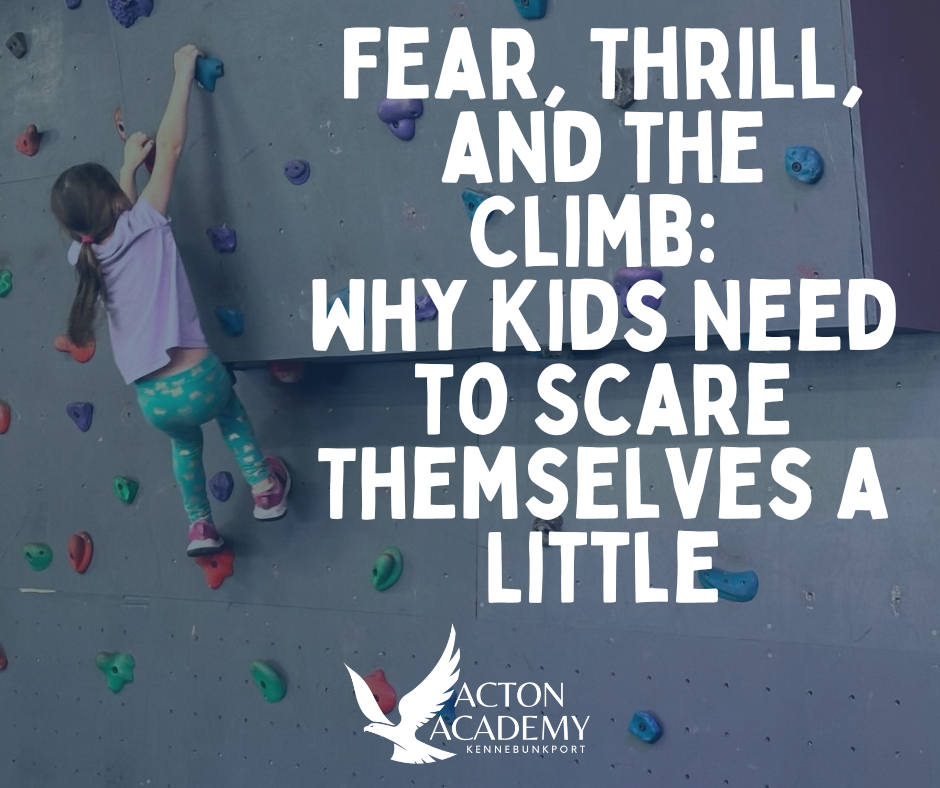
What if one of the best things we could do for our kids is… let them get a little scared?
It sounds strange in a world that’s spent the last two decades obsessing over safety. We’ve designed playgrounds to eliminate risk, supervised every outing, and padded their schedules with adult-led activities. All with love. All with the best intentions.
But in doing so, we may have forgotten something essential: courage doesn’t come from comfort—it comes from facing fear.
And it turns out, kids know this. So do puppies.
The Wilma Story: What a Puppy Can Teach Us About Fear
While writing The Anxious Generation, Jonathan Haidt got a new puppy named Wilma. One day at the dog park, Wilma—still tiny and nervous—encountered a massive German Shepherd. She froze. The shepherd took a step forward, and Wilma bolted in terror.
But then… she came back.
Tail wagging, cautious but curious, she ran around Haidt in a circle—and then ran straight back to the German Shepherd. Again and again, she danced between fear and approach.
She wasn’t trying to prove anything. She wasn’t irrational.
She was dosing herself with fear.
Testing her limits. Building confidence. Becoming resilient.
This, Haidt says, is what children are wired to do too—if we let them.
Fear Isn’t the Enemy—It’s the Training Ground
Whether it’s climbing a tree, jumping off a swing, or walking home alone for the first time, kids naturally seek out activities that stretch their comfort zones. They’re not being reckless. They’re doing something essential: learning how to manage risk.
In fact, play researchers have observed a fascinating pattern. When kids master a skill, they immediately try to make it harder.
-
Skateboarding down a hill? Let’s try a steeper one.
-
Swinging high? Let’s jump off midair.
-
Climbing a tree? Let’s go one branch higher.
Why do they do this?
Because thrill matters. And thrill is a byproduct of risk. When kids voluntarily engage with something that might go wrong—but usually won’t—they build:
-
Confidence
-
Emotional regulation
-
Social skill
-
Physical coordination
-
And perhaps most importantly… courage
You can’t develop these through lectures, safety talks, or carefully controlled experiences. You develop them by doing things that feel scary—and discovering you’re strong enough to handle them.
The Cost of Coddling: What Happens When Fear Disappears
Over the past 15 years, we’ve seen a major shift in parenting culture—especially in the U.S. and U.K. Instead of letting kids climb trees, many parents now say, “That’s dangerous.” Instead of letting kids walk home, we say, “Call me when you arrive.” We supervise everything. We eliminate risk wherever possible.
And now we’re seeing the results:
-
Skyrocketing rates of anxiety and depression
-
Teenagers unable to self-regulate
-
College students overwhelmed by basic challenges
-
A generation that’s not only afraid of getting hurt—but afraid of life itself
We took away the falls and bruises and replaced them with “safety”—but at what cost?
As Haidt puts it: “It’s as if we removed vitamin C from their diet… and were surprised when they got scurvy.”
Fear Builds Strong Brains—and Strong People
This is the heart of Haidt’s argument: children are antifragile.
They’re not just resilient—they’re designed to grow stronger through challenge, fear, and failure. Like a muscle that needs resistance to grow, young humans need adversity (in small, healthy doses) to develop into competent, confident adults.
When we deny kids those doses of fear—when we bubble-wrap their experiences—we deny them something far more important than safety.
We deny them the chance to grow.
So What Can We Do?
This doesn’t mean throwing kids into danger. It means reframing risk as a developmental necessity, not a problem to eliminate.
Here’s how we start:
-
Let them climb — even if it’s high.
-
Let them walk home — even if it makes you nervous.
-
Let them explore — even when you’re not in control.
-
Let them fall — and learn that they can get back up.
Instead of always asking “Is it safe?” let’s start asking:
“Is it worth it for their growth?”
Childhood Was Never Meant to Be Painless
It was meant to be powerful.
It was meant to be full of scraped knees, scary leaps, and bold adventures. Because that’s how kids become capable. That’s how they become brave.
Not from watching videos about bravery.
But from being a little scared—and doing it anyway.
Let’s not rob them of that. Let’s give it back.
If you’re ready to explore how your family or school community can reclaim childhood through intentional risk, real play, and healthier tech norms, get started with our Essential Info Pack here.
