
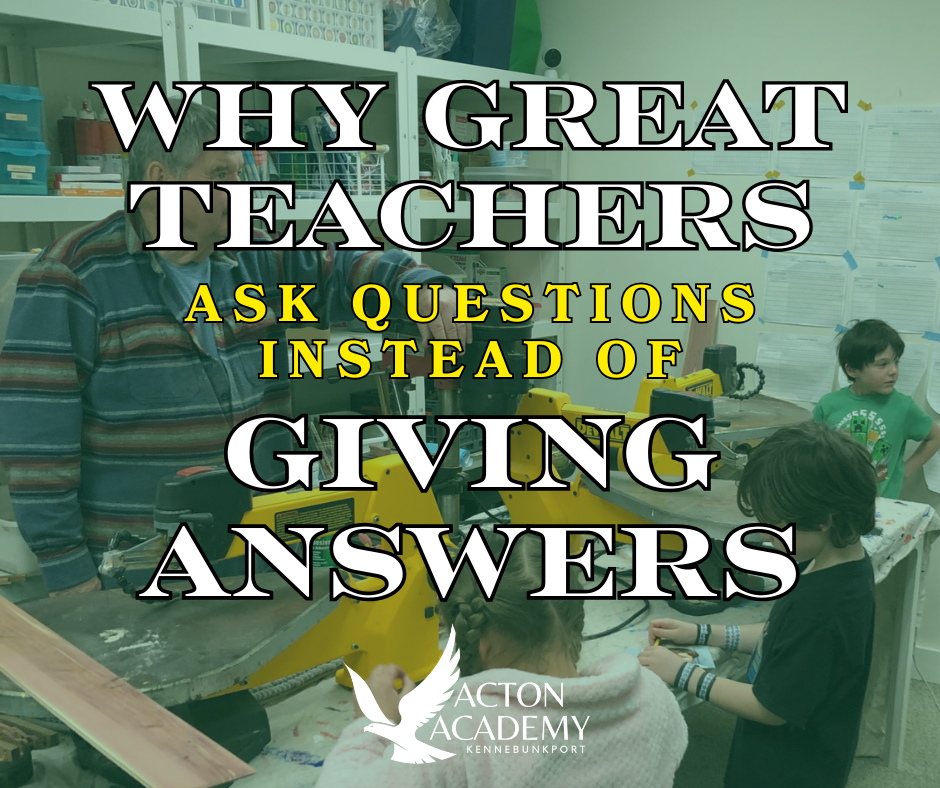
The power of the Socratic method in helping young learners think for themselves
In most classrooms today, learning follows a familiar pattern: the teacher explains, the students listen, and the goal is to remember the answer long enough to pass a test.
But what if the most powerful form of learning happens not when answers are given—but when questions are asked?
This idea lies at the heart of the Socratic method, a teaching approach that has shaped philosophers, leaders, and innovators for centuries. At Acton Academy, it’s one of the foundational tools we use to help learners think independently, explore deeply, and take ownership of their education.
Because when learners discover answers for themselves, the learning becomes far more meaningful—and far more lasting.
Learning That Sticks
Think back to something you truly understand well today.
Chances are, you didn’t learn it simply by being told the answer. Instead, you probably wrestled with it. You experimented, asked questions, made mistakes, and eventually figured it out.
That struggle is not a flaw in the learning process—it’s the engine of learning.
In a conversation between psychologist Jordan Peterson and Acton Academy cofounder Jeff Sandefer, Sandefer described the essence of Socratic teaching in surprisingly simple terms. According to him, much of the Socratic method revolves around just two core questions:
-
What would you do next?
-
What do you mean by that?
These questions sound simple, but they force learners to clarify their thinking. Instead of repeating information, they must form ideas, defend them, and refine them.
Over time, this builds something far more valuable than memorization: the ability to think.
Why Answers Alone Don’t Work
When students are given ready-made answers, two things happen.
First, the learning tends to be shallow. Information that arrives fully packaged often disappears just as quickly.
Second, learners miss the opportunity to develop confidence in their own reasoning. If every solution comes from the teacher, students may begin to believe that thinking is someone else’s job.
The Socratic method flips that dynamic.
Instead of delivering solutions, a guide asks questions that encourage learners to explore possibilities, challenge assumptions, and arrive at conclusions through discussion and experimentation.
In other words, the learner becomes an active participant in discovering knowledge, rather than a passive receiver.
Curiosity Over Certainty
One of the most powerful shifts that happens in a Socratic environment is that curiosity begins to matter more than being right.
Jeff Sandefer once recalled a moment during a discussion when a teacher paused a debate and asked a simple question:
“Would you rather be right, or would you rather be curious?”
That question captures the spirit of the Socratic approach.
When learners feel safe asking questions, exploring ideas, and even changing their minds, the classroom becomes a place of genuine discovery. Instead of defending fixed answers, learners begin to develop the habit of exploring possibilities.
Curiosity becomes the driver of learning.
Preparing Learners for the Real World
In the real world, the most important problems rarely come with answer keys.
Entrepreneurs, scientists, engineers, and leaders must constantly face uncertainty. They must analyze situations, ask good questions, collaborate with others, and test their ideas.
The Socratic method prepares learners for exactly this kind of environment.
By asking questions instead of providing answers, guides help learners develop the skills they will need throughout life:
-
Critical thinking
-
Clear communication
-
Intellectual humility
-
Courage to explore the unknown
These are not skills that can be memorized. They must be practiced.
The Courage to Ask
Perhaps the most important outcome of a Socratic learning environment is that learners begin to realize something powerful:
They are capable of figuring things out.
When learners ask questions, debate ideas, and collaborate with peers, they start to see themselves as problem-solvers rather than simply students.
And that shift—from passive learning to active discovery—changes everything.
At Acton Academy, our goal is not simply to help learners absorb information. Our goal is to help them develop the habits of mind that will guide them throughout their lives.
Because the most important lessons are rarely the answers we memorize.
They are the questions we learn to ask.
Want to Learn More?
At Acton Academy Kennebunkport, learners take ownership of their education through Socratic discussions, real-world challenges, and a community that encourages curiosity and independence.
Download our Info Kit to learn how Acton’s learner-driven model helps young people develop confidence, character, and a lifelong love of learning.
