
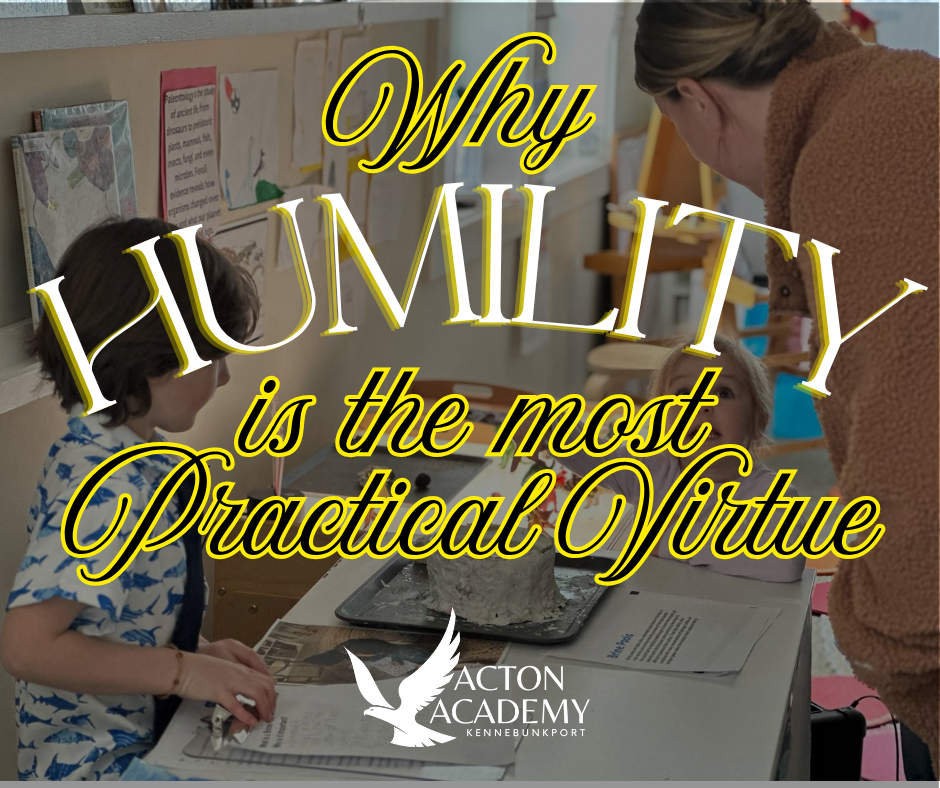
What admitting “I don’t know” teaches learners, parents, and guides about real growth
In a conversation between Jordan Peterson and Acton Academy cofounder Jeff Sandefer, a simple but profound idea emerged — one that captures the very heart of what we try to cultivate at Acton:
True learning begins with humility.
It’s easy to imagine humility as just a moral virtue — something spiritual or polite. But as Peterson noted, it’s far more than that. Humility is practical. It’s what allows children (and adults) to learn, adapt, and grow.
“Humility means the admission of ignorance,” Peterson said.
“And if you dare admit what you don’t know, you immediately rectify it.”
At Acton, we see this truth lived out every day. The young hero who says, “I don’t understand this yet” is the one who’s about to make a breakthrough. The guide who admits, “I don’t have the answer — what do you think?” models exactly the courage and curiosity we hope every learner will carry into the world.
The Power of Asking a “Stupid Question”
Peterson once told his daughter,
“You only have to ask a stupid question once — if you listen to the answer.”
That captures the spirit of the Socratic method perfectly.
Many students in traditional systems are afraid to be wrong, so they stay silent.
At Acton, we flip that script: every question is a door to discovery.
When a learner asks, experiments, or fails forward, they’re not losing — they’re growing.
Because what matters isn’t perfection — it’s persistence and curiosity.
Humility in a Socratic Studio
Jeff Sandefer shared that one of the hardest parts of being a Socratic guide is not asking questions you already know the answer to.
If the question isn’t real, the learning isn’t real.
“If you’re putting your thumb on the scale,” he said, “the learners will know.”
That’s why Acton guides don’t lecture or “fix” things. We ask questions that challenge, clarify, and empower learners to think for themselves.
This practice is humility in action — it’s a recognition that wisdom can emerge from anywhere in the room.
Would You Rather Be Right, or Be Curious?
During one case discussion, a teacher stopped Laura Sandefer mid-debate and said:
“Ask yourself — would you rather be right, or would you rather be curious?”
That question could hang on every studio wall.
Because curiosity, not certainty, is what keeps learning alive.
In a world that rewards quick answers, humility invites wonder. It says, “Let’s explore this together.” It turns competition into collaboration and mistakes into momentum.
How We Practice Humility at Acton
Humility isn’t a slogan here — it’s built into our daily rhythms:
-
Socratic discussions — where asking thoughtful questions matters more than having the perfect answer.
-
Peer feedback and 360 reviews — where learners practice giving and receiving honest input with courage and grace.
-
Hero’s Journey reflections — where each learner looks inward to ask: “What am I learning about myself through this challenge?”
Humility fuels all three. It’s what lets learners confront resistance, distraction, and victimhood — the “three monsters” of growth — and emerge stronger.
The Freedom to Not Know (Yet)
In a culture that often prizes being right, humility gives children something far greater:
The freedom to learn out loud.
When a learner says “I don’t know,” they’ve already taken the first step toward wisdom.
When a parent or guide says the same, they model lifelong learning.
That’s the spirit of Acton — a place where every hero learns to stand up, ask boldly, and keep exploring.
Because in the end, humility isn’t about making yourself smaller.
It’s about staying open to something larger — truth, growth, and the adventure of learning itself.
And that’s why humility is, quite literally, the most practical virtue of all.
Ready to Learn More?
At Acton Academy Kennebunkport, we believe education isn’t about memorizing answers — it’s about developing the character and courage to keep asking better questions.
📘 Download our Info Kit to discover how Acton’s learner-driven model helps young people grow in curiosity, independence, and purpose.
👉 Get the Info Kit Here
