
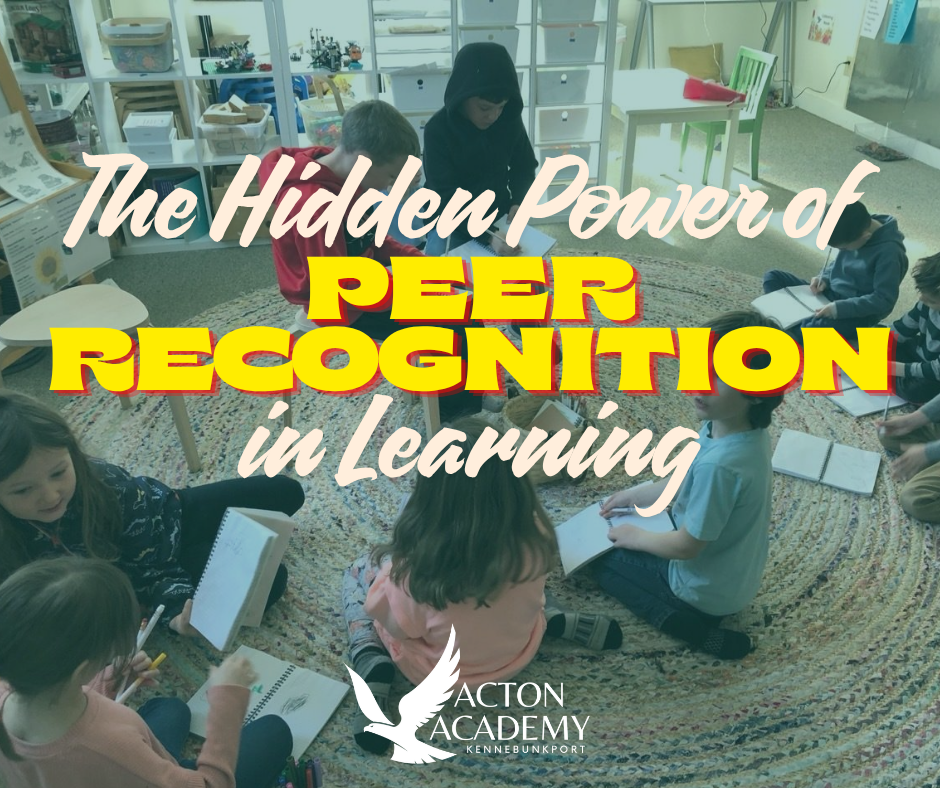
Who should decide what “good work” really is?
In most schools, recognition follows a familiar pattern. A teacher assigns a grade. A student receives it. And that number becomes the measure of success. But what if that system is missing something important? What if the most meaningful recognition doesn’t come from adults at all—but from peers?
At Acton Academy, we’ve seen a powerful shift when learners begin evaluating not just their own work, but each other’s. When recognition becomes something earned within a community, rather than assigned from above, something deeper begins to develop: ownership, accountability, and pride in meaningful work.
The Problem with Traditional Recognition
Grades are simple. They’re efficient. They create clear benchmarks. But they also create unintended consequences.
When learners work primarily for grades:
- They begin to focus on what the teacher wants, not what truly matters
- They aim to complete tasks, rather than master them
- They may avoid risks that could lead to failure
Over time, learning can become transactional:
“What do I need to do to get an A?”
Instead of transformational:
“How can I improve? What can I create? What am I capable of?”
Recognition, in this model, is external—and often temporary.
A Different Approach: Recognition from Within the Community
At Acton Academy, learners experience something different.
Instead of relying solely on adult evaluation, learners:
- Present their work publicly
- Receive feedback from peers
- Evaluate each other’s progress and character
- Earn recognition through demonstrated effort and excellence
This isn’t about removing standards—it’s about deepening them.
In a Socratic learning environment, the question shifts from:
“Did I get a good grade?”
to:
“Does this work stand up to the standards of my community?”
And that question is far more powerful.
Why Peer Recognition Is So Effective
When recognition comes from peers, it changes how learners approach their work in several important ways.
1. The Standards Become Real
In traditional systems, standards often feel abstract. But in a learner-driven community, standards are lived and experienced.
When a learner presents a project—whether it’s a scientific experiment, a business idea, or a piece of writing—they aren’t just submitting it to a teacher. They’re sharing it with an audience that:
- Asks questions
- Offers feedback
- Recognizes effort
- Challenges ideas
The result? Standards are no longer theoretical—they’re visible, tangible, and shared.
2. Feedback Becomes Meaningful
In many classrooms, feedback flows one way: from teacher to student. At Acton, feedback flows in all directions.
Learners practice giving feedback that is:
- Specific
- Honest
- Respectful
Instead of saying, “This is bad,” they learn to say:
“When you interrupted me while I was working, it made it harder to focus. Could you try waiting next time?”
This builds not only better work—but better relationships. It also teaches a critical life skill: how to both give and receive constructive feedback.
3. Effort and Growth Are Recognized—Not Just Outcomes
One of the most powerful elements of peer recognition is that it values progress, not just performance.
In Acton studios, learners track:
- Effort (how hard they worked)
- Progress (how much they improved)
- Mastery (how their work compares to a high standard)
This creates a more complete picture of success. A learner who struggles but persists is recognized. A learner who improves over time is recognized. A learner who helps others grow is recognized.And that kind of recognition builds confidence that lasts far beyond a single assignment.
4. Accountability Becomes Internal
Perhaps most importantly, peer recognition builds internal accountability. When learners know their work will be seen, discussed, and evaluated by their peers, they take greater ownership. Not because they have to—but because they want to.
They begin to ask:
- “Is this my best work?”
- “Would I be proud to present this?”
- “How can I improve before sharing?”
Over time, motivation shifts from external pressure to internal drive. And that’s where real learning begins.
But What About Standards?
A common question is: If adults aren’t assigning grades, how are standards maintained? The answer is: through a combination of community expectations and real consequences.
At Acton:
- Learners earn badges for demonstrated skills and mastery
- Work is presented publicly and evaluated by peers
- Systems exist to ensure fairness and accountability
In fact, learners often hold each other to higher standards than adults might. Because they’re not just completing assignments—they’re building a culture.
Preparing for the Real World
In life beyond school, success is rarely determined by a single authority figure.
Instead, it’s shaped by:
- Feedback from colleagues
- Responses from clients or customers
- Collaboration with teams
- Reputation within a community
Peer recognition prepares learners for this reality.
It teaches them how to:
- Present ideas clearly
- Accept feedback with humility
- Improve through iteration
- Contribute meaningfully to a group
These are the skills that matter—not just in school, but in life.
A New Definition of “Good Work”
So who should decide what “good work” is? At Acton Academy, the answer is not just the guide.
It’s the community of learners.
Because when recognition comes from peers:
- Work becomes more meaningful
- Standards become more real
- Learning becomes more personal
And most importantly, learners begin to see themselves not just as students—but as contributors.
Ready to Learn More?
At Acton Academy Kennebunkport, learners take ownership of their work, their growth, and their role in a community that values excellence and character.
Download our Info Kit to discover how Acton’s learner-driven model helps young people build confidence, accountability, and a lifelong love of learning.
