
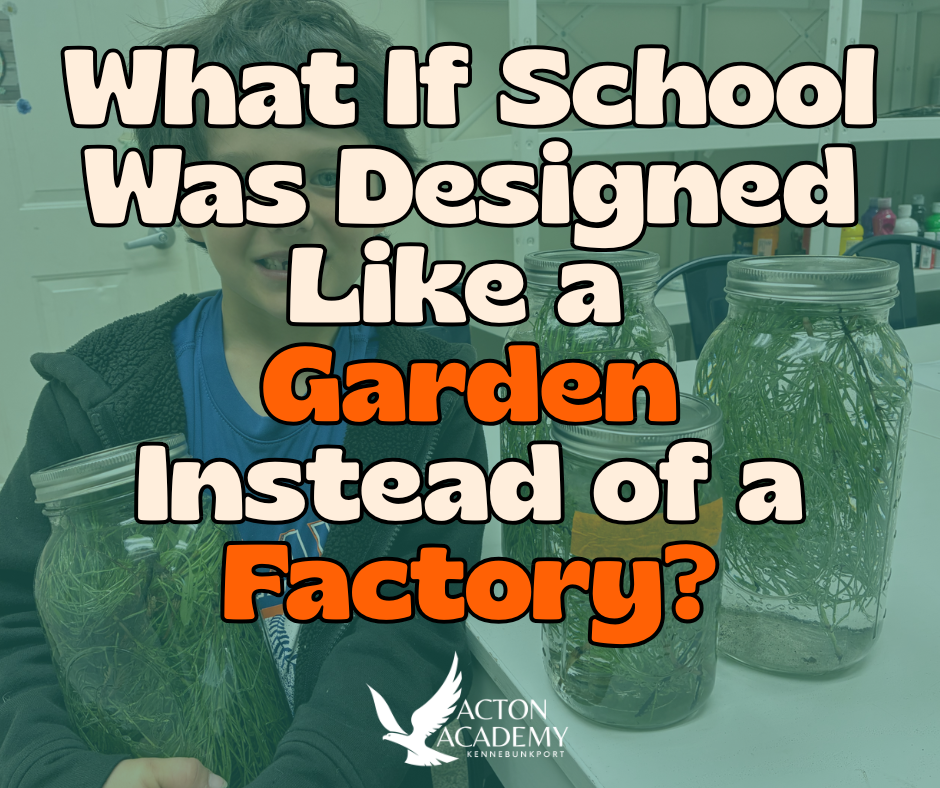
For more than a century, most schools have been built around an industrial model of education. Students move through the system in batches based on age. Everyone follows similar schedules, studies similar material, and is measured against standardized benchmarks. The structure rewards efficiency, conformity, and predictability. But children are not products on an assembly line. They are unique individuals with different gifts, interests, personalities, and timelines for growth.
That’s why educator Sir Ken Robinson once argued that education must move away from an industrial mindset and toward something far more organic:
“We have to move to a model that is based more on principles of agriculture.”
It’s a simple metaphor, but a profound one. Because if you think about it, the best schools don’t operate like factories. They operate more like gardens.
Factories Standardize. Gardens Cultivate.
A factory is designed for uniformity. Every process is optimized to produce the same result repeatedly and efficiently.
A garden works differently.
In a garden, growth is not forced. It’s cultivated. Different plants grow at different speeds. Some flourish in direct sunlight while others thrive in shade. Some bloom early. Others take time. A wise gardener doesn’t expect every seed to develop on the same timeline.
Instead, they focus on creating the right conditions for growth. That mindset changes everything. Because children are not standardized products. They are human beings with different talents, curiosities, and callings.
Yet traditional education systems often treat differences in growth as problems to fix instead of realities to nurture. A child who struggles in one environment may thrive in another. A student who appears disengaged in a conventional classroom may come alive when given freedom, responsibility, or meaningful work. Some young people discover their passions early. Others discover them much later.
Human growth is not mechanical. It’s organic.
The Pressure to Follow One Path
As another school year comes to a close, many students feel the weight of expectations. Grades. Test scores. College applications. Class rankings. Career decisions. The pressure to follow a predetermined path can make students feel like they are falling behind before they’ve even had the chance to discover who they are.
But life is rarely linear.
Some students are ready for college immediately after high school. Others flourish through entrepreneurship, apprenticeships, travel, creative pursuits, or real-world experiences first. Some learners thrive academically. Others thrive through building, leading, creating, or serving.
The problem is not that students are different. The problem is that many educational systems still expect them to grow the same way.
At Acton Academy, the belief is fundamentally different: every child is on a unique Hero’s Journey. That means growth cannot always be measured by standardized timelines or identical outcomes. And that’s okay.
Summer Shouldn’t Only Be About Productivity
Summer break often becomes another season of pressure. Parents worry about “falling behind.” Students rush to fill schedules with activities, camps, tutoring, and resume-building opportunities. Even rest can start to feel unproductive.
But what if summer was viewed differently?
What if summer became a season for exploration instead of optimization?
Some of the most meaningful growth in a young person’s life happens outside traditional academic settings:
- Starting a small business
- Learning a practical skill
- Exploring nature
- Reading out of curiosity
- Solving real-world problems
- Creating art or music
- Working with others
- Having unstructured time to think
Growth does not only happen through assignments and assessments. Sometimes growth happens through freedom. Sometimes children need space to experiment, fail, reflect, and discover what genuinely excites them. A garden cannot flourish if every inch is overcontrolled. Neither can a child.
Personalized Learning Isn’t Lowering Standards
One of the biggest misconceptions about personalized education is that it lowers expectations. In reality, it raises them. Because personalization requires educators to see students as individuals rather than categories.
Not every child learns the same way. Not every child is motivated by the same things. And not every form of intelligence fits neatly into standardized testing. The future will reward creativity, adaptability, initiative, collaboration, and problem-solving far more than memorization alone. That’s why environments that empower young people to take ownership of their learning matter so much.
When students are trusted with responsibility, challenged to solve meaningful problems, and encouraged to pursue work that matters to them, something changes. Learning becomes personal. And when learning becomes personal, it becomes powerful.
Creating the Conditions for Flourishing
A gardener cannot force a plant to grow. But they can create the conditions where growth becomes possible. That may be one of the most important lessons for education today. Parents and educators do not need to manufacture identical outcomes for every child. They need to cultivate environments where curiosity, resilience, independence, creativity, and purpose can flourish.
Because every child carries gifts that may not immediately appear on a report card. Some bloom early. Others bloom later. But all deserve the opportunity to grow in environments that recognize their individuality instead of forcing conformity.
As this school year ends and summer begins, perhaps the question isn’t:
“How do we produce better students?”
Perhaps the better question is:
“How do we help young people flourish?”
Like a garden, the answer starts with the environment.
Discover a Different Kind of Education
At Acton Academy, we believe every child is capable of extraordinary growth when given the right environment, meaningful challenges, and the freedom to take ownership of their learning. If you’re exploring a more personalized, learner-driven approach to education, our free information kit is a great place to start and learn how we’re helping young heroes discover their unique path and prepare for a changing world.
