
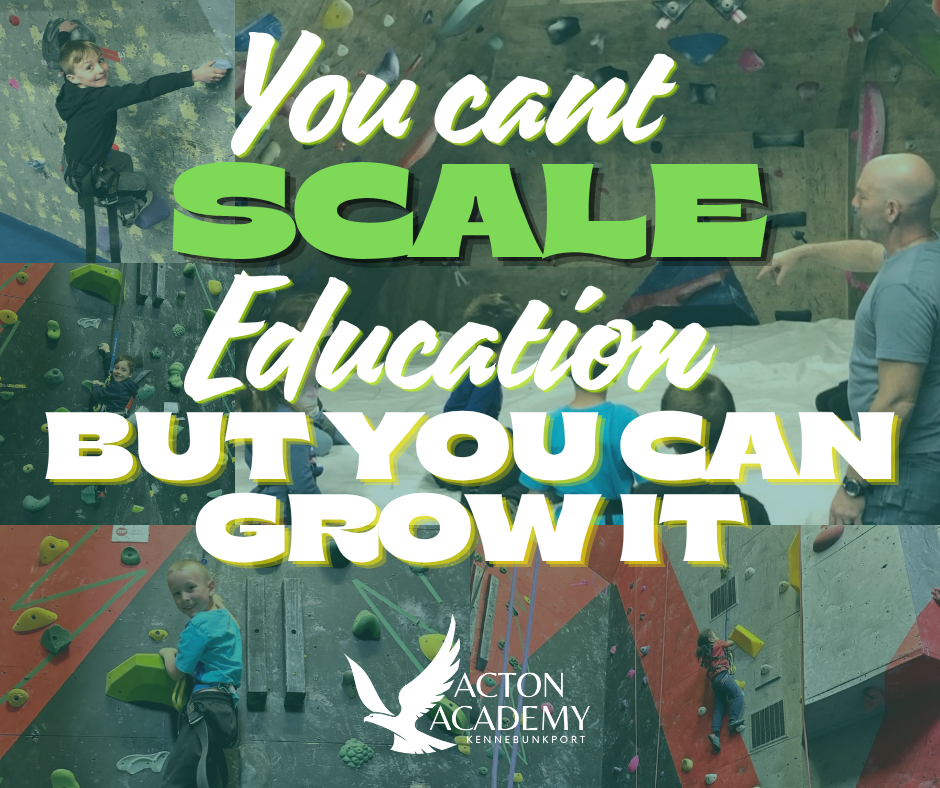
In a world driven by efficiency and expansion, the idea of scaling has become central to how we solve problems. When something works, the instinct is to replicate it—to standardize it, systematize it, and apply it as widely as possible.
This approach has transformed industries. But when it comes to education, it raises an important question:
Can learning really be scaled?
At first glance, the answer seems straightforward. If a school is successful, why not replicate its model? Why not take what works—its curriculum, structure, and systems—and apply it elsewhere? The challenge is that education is not a product. It is a deeply human process.
The Problem with “Scaling” Schools
Children are not uniform. They do not think the same way, learn at the same pace, or respond to the same methods. Each child brings a unique combination of interests, strengths, struggles, and experiences into the learning environment. Yet many traditional systems treat them as if they are interchangeable—grouping them by age, moving them along fixed timelines, and measuring them against standardized benchmarks.
In the pursuit of scalability, something essential is lost: individuality. When education is designed for efficiency rather than for people, it begins to resemble a system built for output rather than for growth. The result is often disengagement, lack of ownership, and a disconnect between learning and real life.
Why Copying “Top Schools” Doesn’t Work
It is tempting to look at a high-performing school and assume that success can be replicated by copying what is visible—its schedule, curriculum, or structure. But what makes a school truly effective goes far beyond these surface-level elements. Success is shaped by culture, relationships, and context. It depends on the specific learners in that environment, the values of the community, and the way educators respond to individual needs.
These are not things that can be duplicated. A model that thrives in one setting may not translate to another, not because it is flawed, but because it was designed for a different group of learners. When schools attempt to replicate outcomes without understanding the conditions that created them, they often fall short. The result is a system that looks right on the outside but lacks the depth that makes learning meaningful.
Education Isn’t Mechanical—It’s Organic
To move forward, we need to rethink how we view education itself. For too long, education has been approached with a mechanical mindset—as something that can be engineered, controlled, and delivered in a predictable sequence. In this model, learning is treated as a process that can be optimized through standardization. But real learning does not work that way. Human development is organic. It is shaped by curiosity, motivation, relationships, and environment. It is not linear, and it cannot be forced into a uniform structure.
A more accurate metaphor for education is agriculture. A farmer does not build a plant or control exactly how it grows. Instead, they focus on creating the right conditions—healthy soil, proper sunlight, and consistent care. Growth happens naturally as a result. The same is true for learning. Educators cannot manufacture curiosity or prescribe passion. What they can do is create environments where these qualities are able to emerge and grow.
The Power of Local, Personalized Learning
When we shift from trying to scale education to trying to grow it, a new possibility emerges. Instead of designing systems for the “average” student, schools can become deeply responsive to the actual learners in front of them. Learning becomes personalized, not just in content, but in pace, approach, and purpose. This kind of environment allows students to engage more deeply. They begin to take ownership of their learning, exploring their interests and developing their strengths in meaningful ways. It also allows schools to reflect their communities. What works in one environment may look very different in another—and that is not a weakness. It is a reflection of the diversity of human potential. When learning is local and personalized, schools stop functioning like factories and begin to operate more like ecosystems—dynamic, adaptive, and alive.
Growth Over Replication
The future of education is not about finding a single model that can be scaled everywhere. It is about creating conditions where many different models can grow. This requires a shift in mindset. Instead of asking, “How do we scale this system?” we begin to ask, “How do we create the conditions for this to thrive?”
That question changes the focus from control to possibility. It recognizes that education is not about producing identical outcomes, but about nurturing individual potential. Different learners need different paths. Different communities need different solutions. And when those differences are embraced rather than eliminated, education becomes far more powerful.
A Final Thought for Parents
Every child carries something unique—interests, abilities, questions, and dreams that develop over time. These cannot be standardized or rushed. They grow when children are placed in environments that encourage exploration, support independence, and allow them to discover who they are.
The goal, then, is not to find a perfect system. It is to find—or help create—the right conditions. Because education is not something that can be scaled. It is something that must be cultivated. And when the conditions are right, growth is not only possible—it is inevitable.
If you’d like to learn more about how this looks in practice, we invite you to download our info kit.
